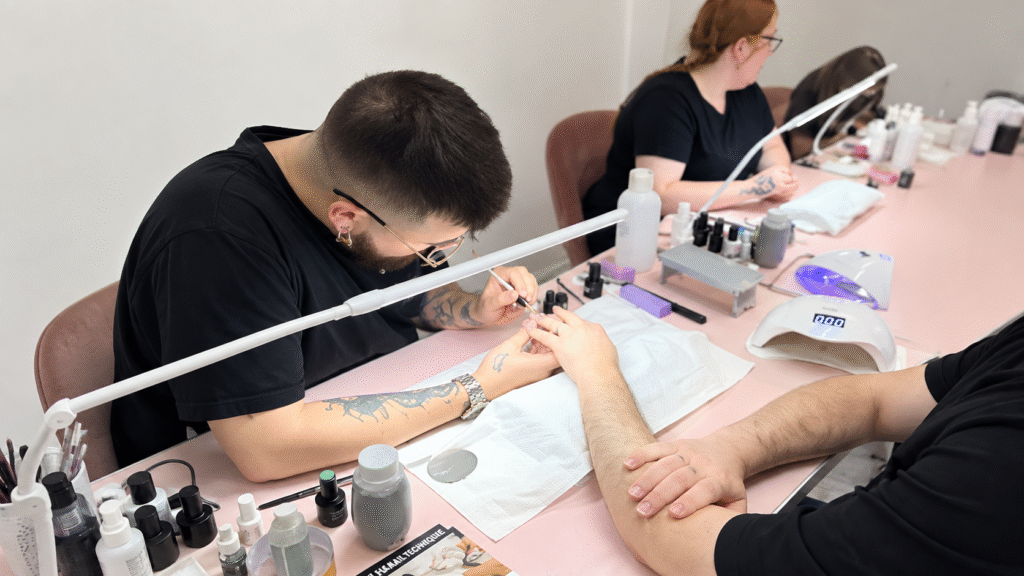
The modern nail industry offers far more than traditional manicures and polish. Clients now regularly ask for BIAB, gel polish, builder gel, acrylic nails, hard-gel extensions and structured overlays, which means future nail technicians need to understand several systems rather than learning only one.
For students in Dubai, the best approach is usually to build a broad foundation first, then specialise in the techniques that best match the type of clients and salon environment you want to work with.
Students who want comprehensive training across professional nail services can explore the Complete Nail Technician Course.
Students planning a broader professional pathway can also read How to Become a Nail Technician in Dubai.
Why Nail Technicians Should Learn More Than One System
Clients do not all want the same result.
One client may want a simple glossy gel manicure. Another may want extra strength over natural nails. Someone else may want long sculpted extensions.
A professional nail technician therefore needs to understand how different systems work and when each may be appropriate.
Important nail systems include:
- Gel polish
- BIAB or builder gel
- Acrylic
- Hard gel
- Nail extensions
- Natural-nail overlays
- Refills and maintenance
- Safe removal
Dubai nail salons commonly offer several of these services within the same treatment menu, including gel polish, BIAB, acrylic and extensions.
1. What Is Gel Polish?
Gel polish is one of the most common services for nail technicians to learn.
It is applied in thin layers over the natural nail and cured using an appropriate UV or LED lamp.
Gel polish is primarily designed to provide:
- Long-lasting colour
- Glossy finish
- Improved chip resistance compared with traditional polish
- A polished natural-nail appearance
A typical gel service involves:
- Nail preparation
- Cuticle work
- Base coat
- Colour application
- Curing
- Top coat
- Finishing
- Safe removal
Why Gel Is a Good Foundation Skill
Gel polish teaches many important beginner skills.
Students develop:
- Product control
- Cuticle-area precision
- Nail preparation
- Thin-layer application
- Correct curing
- Nail shaping
- Safe removal
These techniques form a foundation for more advanced nail services.
2. What Is BIAB?
BIAB stands for Builder In A Bottle.
The term is associated with a builder-gel system applied from a bottle, although “BIAB” is also often used informally to describe similar builder-gel services.
Compared with standard gel polish, builder gel is generally thicker and designed to add more structure to the natural nail.
It may be used for:
- Strengthening natural nails
- Creating structured overlays
- Supporting nail growth
- Correcting minor shape issues
- Adding some additional structure
Dubai salons currently advertise BIAB as a distinct service alongside standard gel manicures and extensions.
Skills Needed for BIAB
BIAB application requires more technical control than a simple gel-polish manicure.
A technician should understand:
- Nail preparation
- Product consistency
- Slip layer
- Product placement
- Apex creation
- Sidewall structure
- Curing
- Refining
- Infills
- Safe removal
The objective is not simply to apply a thick layer of gel.
The technician needs to create enough structure while maintaining a clean and natural-looking nail.
3. Gel vs BIAB: What Is the Difference?
Gel polish and BIAB are related nail services, but they perform different roles.
Gel Polish
Gel polish is mainly used for:
- Colour
- Shine
- A neat manicure finish
- Longer wear than standard polish
It generally adds limited structural support.
BIAB / Builder Gel
Builder gel is thicker and is used to create more:
- Strength
- Structure
- Support
- Shape correction
For clients who want natural-looking nails but need additional reinforcement, builder gel may be more suitable than standard gel polish.
A skilled nail technician should understand both systems.
4. What Are Acrylic Nails?
Acrylic is another professional nail-enhancement system.
Traditionally, acrylic uses a liquid monomer combined with polymer powder to create a workable bead that the technician shapes over the natural nail or extension.
Unlike gel systems, traditional acrylic does not depend on a UV or LED lamp to harden.
Acrylic can be used for:
- Nail extensions
- Structured overlays
- Added strength
- Nail repairs
- Longer nail shapes
Dubai salons continue to offer acrylic services alongside BIAB, gel and hard-gel extensions.
Acrylic Requires Strong Product Control
Acrylic technique takes practice because technicians need to control:
- Liquid-to-powder ratio
- Bead size
- Product placement
- Working speed
- Nail structure
- Apex
- Filing
- Finishing
Poor product control can result in:
- Bulky nails
- Uneven structure
- Excessive filing
- Lifting
- Inconsistent shapes
For beginners, acrylic can take longer to master than gel polish.
5. What Are Nail Extensions?
The term nail extensions refers to techniques used to add length beyond the client’s natural nail.
Extensions may be created using:
- Acrylic
- Hard gel
- Builder gel
- Full-cover tips
- Sculpting forms
- Other professional extension systems
This means “extensions” are not necessarily one specific product.
They describe the result — added length — while acrylic or gel describes the type of product or system used to create that result.
Skills Needed for Extensions
Professional extensions require knowledge of:
- Nail preparation
- Tip or form placement
- Extension length
- Nail architecture
- Apex placement
- Sidewalls
- C-curve
- Filing
- Symmetry
- Maintenance
- Infills
- Safe removal
The longer the nail becomes, the more important the structure becomes.
6. BIAB vs Acrylic: Which Skill Is More Useful?
Both are useful, but they serve different client needs.
BIAB May Be Useful for Clients Who Want:
- Natural-looking nails
- Additional strength
- Short-to-medium length
- Structured natural nails
- Regular maintenance
Acrylic May Be Useful for Clients Who Want:
- Significant added length
- Stronger extensions
- Dramatic shapes
- Nail reconstruction
- More elaborate enhancement work
A future technician should ideally understand both systems rather than assuming one completely replaces the other.
7. Gel Extensions vs Acrylic Extensions
Gel and acrylic extensions can both add length, but the application experience differs.
Gel Extensions
Gel systems generally require curing under UV or LED light.
Technicians may prefer gel because of:
- Controlled application
- Different viscosity options
- Clear curing stages
- Glossy finish
Acrylic Extensions
Acrylic begins setting through a chemical reaction once the powder and liquid are combined.
The technician therefore needs to work within the product’s setting time.
This requires strong timing and bead-control skills.
Neither system is automatically “better.”
The right choice depends on:
- Client needs
- Natural nail condition
- Desired length
- Desired shape
- Technician training
- Product system
Students who want a more detailed comparison can also read Gel Extensions vs Acrylic Extensions.
8. Which Nail Skill Should Beginners Learn First?
A logical training sequence is:
- Natural nail preparation
- Manicure techniques
- Gel polish
- Builder gel or BIAB
- Nail extensions
- Acrylic or hard-gel systems
- Nail art
- Advanced shaping
This progression allows students to build precision before working with more complex enhancement products.
The Complete Nail Technician Course is particularly useful for students who want to build several nail skills within one structured pathway.
9. Natural Nail Preparation Comes First
No matter which nail system you learn, preparation is essential.
Professional nail preparation may include:
- Nail assessment
- Removing previous products
- Shaping
- Cuticle preparation
- Removing surface debris
- Appropriate surface preparation
- Dehydration where required
Poor preparation can contribute to lifting or poor longevity.
A nail technician should therefore master preparation before focusing on complicated nail art or extensions.
10. Understanding Nail Architecture
Nail architecture becomes especially important when working with builder gels, acrylic and extensions.
Key areas include:
- Apex
- Sidewalls
- Free edge
- Balance
- Thickness
- Stress area
The goal is to create a nail that looks refined while maintaining appropriate structure.
A nail that looks attractive but is badly structured may be more likely to crack or break.
11. Filing Skills Are Essential
Professional nail technicians need strong manual and electric filing skills.
Filing may be used to:
- Shape natural nails
- Refine acrylic
- Refine builder gel
- Correct extension shape
- Remove bulk
- Prepare for infills
Technicians need to understand:
- File grit
- Pressure
- Filing direction
- E-file speed
- Bit selection
- Safety around the natural nail
Over-filing can damage natural nails, so control is more important than speed.
12. Learn Safe Removal
Every nail technician should learn removal as carefully as application.
Different systems may require different removal methods.
These can include:
- Soaking
- Filing
- Partial product removal
- Rebalancing
- Infilling
Technicians should know whether a particular product is designed to soak off or must be filed down.
Clients should also be advised not to peel off products themselves.
13. Learn Infills and Maintenance
Professional nail work is not only about creating new sets.
A large part of the job involves maintaining existing work.
Clients may return for:
- Builder-gel infills
- Acrylic refills
- Extension maintenance
- Nail repairs
- Colour changes
Maintenance skills are valuable because repeat appointments can become an important part of a nail technician’s regular client base.
14. Learn Professional Nail Art
Once foundational skills are strong, technicians can add creative services.
Popular nail-art techniques include:
- French tips
- Chrome
- Ombre
- Glitter
- Foils
- Marble
- Minimal line art
- Dot designs
- Seasonal nail designs
Dubai nail salons commonly offer both classic nail services and more elaborate extension or nail-art treatments.
15. Which Skills Are Most Useful in Dubai?
A technician working in Dubai may encounter a very broad range of client preferences.
Some clients want:
- Natural nude BIAB
- Minimal gel manicures
- Short structured nails
Others may request:
- Long acrylic extensions
- Coffin nails
- Almond nails
- Chrome finishes
- French extensions
- Detailed nail art
Dubai nail menus currently include gel, BIAB, acrylic, hard gel and multiple extension options, which suggests technicians benefit from learning a broad treatment mix rather than a single system.
16. Which Nail Skill Is Best for Salon Work?
For salon work, versatility can be valuable.
A strong foundation may include:
- Manicure
- Pedicure
- Gel polish
- Builder gel
- BIAB-style overlays
- Extensions
- Acrylic
- Infills
- Removal
- Nail art
This allows technicians to serve different client needs without having to turn away treatments simply because they know only one system.
17. Which Skill Is Best for Freelance Nail Technicians?
Freelance or independent technicians may choose to specialise more heavily.
For example, someone may build a brand around:
- BIAB natural nails
- Minimal nail art
- Luxury gel manicures
- Acrylic extensions
- Bridal nails
However, even specialists benefit from understanding foundational nail systems.
It helps them assess clients correctly and understand alternative treatment options.
18. Build Your Broader Beauty Skill Set
Some nail technicians eventually add complementary beauty services.
Students who want to expand into lash and brow treatments can explore the Complete Lash & Brow Technician Course.
Those interested in beauty and wellness treatments can explore the Complete Spa Therapist Course.
Students wanting to move into professional skincare can consider the Ultimate Skin Specialist Diploma.
Building additional skills should be gradual.
It is generally better to become confident in one professional area before trying to offer too many treatments at once.
BIAB vs Gel vs Acrylic vs Extensions: Quick Comparison
| Skill | Main Purpose | Added Length? | Structural Support | Difficulty |
|---|---|---|---|---|
| Gel Polish | Colour and finish | No | Low | Beginner |
| BIAB / Builder Gel | Strength and structure | Limited | Medium–High | Intermediate |
| Acrylic | Strong enhancements | Yes | High | Intermediate–Advanced |
| Gel Extensions | Added length and shape | Yes | High | Intermediate–Advanced |
What Should You Learn First?
For someone starting from scratch, a strong order is:
Gel polish → Builder gel/BIAB → Extensions → Acrylic → Advanced shaping and art
This progression helps students develop hand control and product knowledge before moving into more technically demanding services.
The Complete Nail Technician Course can provide a broader starting point for building professional nail skills.
Frequently Asked Questions
1. What is the difference between BIAB and gel polish?
Gel polish is mainly used for colour and a glossy long-wear finish. BIAB or builder gel is thicker and provides more structure and reinforcement to the natural nail.
2. Is BIAB the same as builder gel?
BIAB refers to Builder In A Bottle, a specific type of bottled builder-gel system. The term is also commonly used informally for similar structured builder-gel treatments.
3. Are acrylic nails and extensions the same thing?
Not exactly. Acrylic is a product system. Extensions refer to added nail length and can be created using acrylic, gel or other systems.
4. Which nail technique is easiest for beginners?
Gel polish is often a practical starting point because it teaches nail preparation, product control, curing and finishing before students progress into structured enhancements.
5. Should nail technicians learn BIAB?
Builder-gel skills can be useful because many clients want additional natural-nail strength without dramatic extensions. Dubai salons currently list BIAB as a common nail service.
6. Should nail technicians learn acrylic?
Acrylic remains useful for technicians who want to offer longer extensions, structured enhancements and more dramatic nail shapes.
7. Which course can I take for professional nail training in Dubai?
Students looking for broad nail education can explore the Complete Nail Technician Course.
8. Is practical training important?
Yes. Gel, builder gel, acrylic and extension techniques require hand control, correct product placement and accurate filing. Practical training is essential for developing consistency.
9. Can nail technicians add other beauty services later?
Yes. Nail technicians may later add complementary qualifications such as the Complete Lash & Brow Technician Course or Complete Spa Therapist Course.
10. Which nail skills are most useful in Dubai?
A broad combination of gel polish, BIAB or builder gel, acrylic, extensions, maintenance and nail art can help technicians work with the wide variety of nail services currently offered across Dubai salons.